Wednesday, September 14, 2011

Rene Magritte


Rene Magritte (1898-1967)


Rene Magritte was twelve years old when his mother, Regina, committed suicide by drowning herself into the Sambre River. According to a nurse, the little boy was present when his mother's body was retrieved from the river, though her face had been covered. Of what little is known about Magritte's early life, this tragic story stands out eerily. Magritte went on to puzzle many art critics by painting numerous figures with their faces obscured by objects--or covered. He also painted numerous landscapes of the Sambre River.


L'invention de la vie by Rene Magritte, 1928

Magritte's earliest works, dating back to 1915, were reminiscent of Impressionist artists'. He probably honed these skills at the Académie Royale des Beaux-Arts in Brussels, where he studied until 1919, finding it suffocating and uninspiring. Magritte's paintings after his departure show him going against everything he had been taught, he dabbled in cubism, futurism, and oddly manipulated female nudes.
In 1922, twenty-four year old Magritte married Georgette Berger, who was a childhood friend, as well as a former Academie classmate. Like Magritte, Georgette enjoyed the unexplored territories of art.

From 1922 to 1923, Magritte designed wallpapers for a company, and was a poster and advertisement designer until 1926, when he began to pursue painting full time. This didn't work out too well, at first. It seemed the critics just weren't ready for surrealism. Depressed, Magritte returned with Georgette to Brussels in 1930 and resumed his work in advertising.


Beautiful newlyweds Rene and Georgette Magritte

Convinced that Magritte had something special, fellow surrealist Edward James allowed he and Georgette to rent his London apartment and featured two of Magritte's pieces, Le Principe du Plaisir (The Pleasure Principle) and La Reproduction Interdite (Not to be Reproduced). Magritte finally began to receive the recognition he deserved. World War I had hardened the public, but it had also opened their minds to new possibilities in art, literature, and fashion. Just like Ernest Hemingway's to-the-point prose and Coco Chanel's high quality but spare dresses, Magritte's art captured the "scarred but smarter" attitude felt around the globe.


Le Principe du Plaisir (The Pleasure Principle)


La Reproduction Interdite (Not to be Reproduced)

During the German occupation, Magritte stayed in Brussels. Throughout his career, Magritte had expressed his deepest emotions through painting. His works during the German occupation used violent, bright, bold, patterns, a rebellion to the isolation and alienation he felt in German occupied Belgium. However, after the war, he turned his back on this "savage" style, wanting to "lighten up" surrealism.


Magritte's art was exhibited in the United States first in 1936, and then after his death at the Museum of Modern Art and the Metropolitan Museum of Art in 1965 and 1992. Artists all around the world became exposed to, and fell in love with, Magritte's way of thinking, ushering in a new age of surrealists, who used metals, recycleables, clay, and other unorthodox items to create art. As the pop art age of the 1960s took hold, Magritte's art inspired British and American teens who wanted to think outside the box of their society.


"The Treachery of Images" by Rene Magritte 1929

How was your subject influenced by a particular cultural movement?

After he dropped out of the Académie Royale des Beaux-Arts, Magritte vented his resentment of the old-fashioned ideals being forced upon him by experimenting with radical new techniques. Magritte soon found out that there were other artists who felt the same way he did. They were called surrealists, and they didn't play by anyone else's rules. Surrealists bent the classic idea of art, manipulating seemingly simple scenes into thought provoking, sometimes almost dream-like images. As Magritte became acquainted with more and more of these revolutionary thinkers, his style of painting matured and blossomed into surrealism.


What are some major themes that your subject addresses?

Magritte was loved for the quirky, hidden meanings within his work. He wanted the viewer to form their own idea of what the image they were seeing meant. If they have an idea that contradicts the norm, the should embrace it, not bury it under traditional thinking, as Magritte had been taught to at the Academie. With the Great Depression taking it's toll on the world's economy, people were sick and tired of looking at the same bright, romanticized scenes painted just for the sake of being pretty. Magritte's art was the surreal of the surreal. It bent the typical rules of art, leaving the viewer asking questions; "What am I really seeing?" and "What else could this image mean?"


Links to Magritte's work:

http://www.magritte-gallery.com/


Lizzie J.

French 1: Class Culture


Christo and Jeanne-Claude


Both of the artist were born on the same day, June 13, 1935. They first met in October 1958 in Paris, France. When they met Christo was doing a painting of Jeanne-Claude's mother. He was first attracted to her half sister Joyce. Jeanne-Claude was engaged when she first met Christo. She ended up pregnant by Christo and she still got married, but after the honeymoon she left her husband and went to Christo. They soon had a son named Cyril born on 11 May 1960. Jeanne-Claude's parents didn't approve of the relationship because of Christo's refugee status.


There works were just credited to Christo until 1994, when Jeanne-Claude finally got credited to there work. They rode in separate planes so if one was to crash the other could continue on with the work. This work of art above is called The Wall. It was finished on April 6,1999. Most of there art is made out of fabric, large curtains, wrapped forms, surrounded islands, and large umbrellas.


The photo on the left is called Surrounded Island. It was complete on May 7, 1983, where they covered 11 islands. They completed this piece of art in Biscayne Bay, between the city of Miami, North Miami, the Village of Miami Shores, and Miami Beach.


The photo on the right called Over the River, for the Arkansas river. He did this in dedication to Jeanne-Claude after she passed. It was a dream of there's to do this so he wanted to continue on after her death.


Some of Christo and Jeanne-Claud's themes for there art was environmental. They did alot of things with water and covering bridges, islands, and gates. They respond to alot of cultural movements "Freedom." When Christo escaped communism he felt the need to express it in his art. The significance of there art is love, beauty, freedom, joy, and urban lifestyle.


Monday, September 12, 2011

Niki de Saint Phalle: une artiste française

For my first post on French Contemporary art, I thought I'd share one of my favorite female artistes, Niki de Saint Phalle.


Niki with husband, sculpter Jean Tinguely

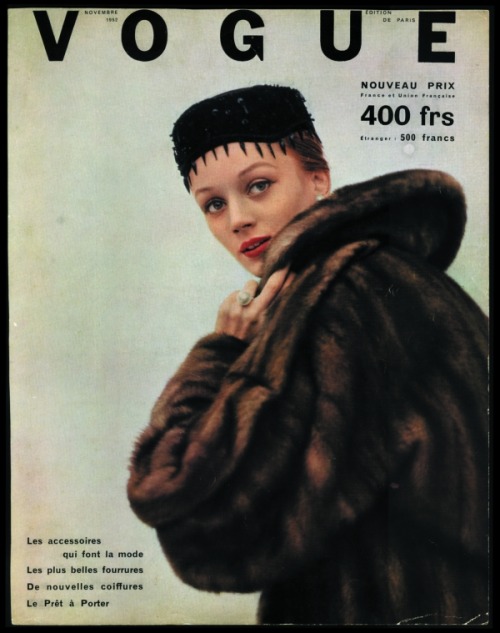
Niki de Saint Phalle's haute class, but financially broken family was driven out of Paris during the Great Depression. After reinstalling in New York in 1933, her mother, your typically glamorous parisienne, enrolled Niki in the prestigious Brearly School where she was promptly dismissed for painting red fig leaves on the school's statuary. From then on Niki was was sacheted from prep school to prep school until she learned to hone her beauty and chipped out shoulders into a modeling career. At the age of 16, her prim n' trim mademoiselle face appeared on the cover of Life Magazine and three years later on the cover of French Vogue.


At 18, Niki eloped with childhood friend, Harry Matthews, shot-gunning herself into a life that she quickly grew to hate. In 1953, she suffered a tremendous nervous breakdown, moved to Spain and started to ferociously paint away her troubles.

After dabbling briefly in oil painting and collage art, she famously turned to a new medium--the rifle. She cocked her gun, aimed and fired at giant paint-loaded canvases.


Shooting Picture, 1961

The point of the "shooting paintings" was to bomb, to FIRE!, to BLOW UP!! this house-cat life she had led by default. It was a big, loud NO! to her hypocritical, sexist society.

Her next art phase had a lot to do with auto-destruction and the rabid consumption of pointless, plastic materials. That means a lot of dismembered Barbie dolls, shredded stuffed animals, and cheap "female" products strangely manipulated and cemented onto canvases.


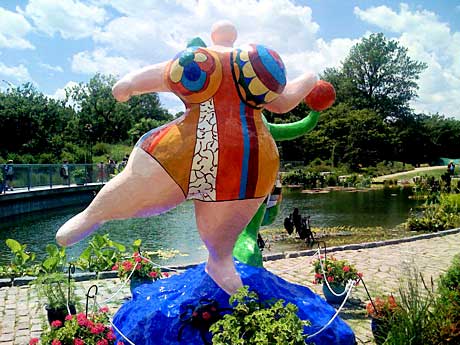
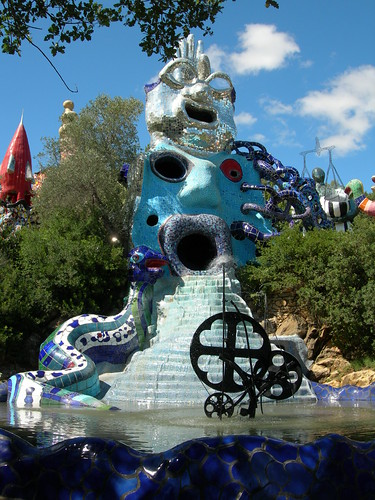
As the 1960s turned into the 1970s, Niki's name got bigger, and so did her art. Um... like a LOT bigger. In 1979, she acquired a stretch of land in Garavicchio, Tuscany and began the 19-year Tarot Garden project that she worked on into her seventies. The bright, fiber-glass Tarot women came to personify her entire career. A visual feast for critics, kids, and even the non-art-inclined, visitors can climb up the heads, slide down the tongues, walk between the legs, and look out the eyes of these creatures even today.


How has your subject influenced French culture?

Niki de Saint-Phalle was part of the 1970's feminist movement in France. Along with other famous french feminists like Simone de Beauvoir, her work challenged the conventional roles that women held in society at that time. It was not very "feminine" for a woman to pick up a rifle back then. Women were looked down upon for being boisterous and unconventional, when society expected them to look pretty, wear high heels, and act proper. Niki's work made French women, and women around the world, realize that if they have something to say, they are allowed to scream it, and if they have something to show the world, they can used big, loud colors.

How has your subject influenced a particular cultural movement?

Niki de Saint Phalle is part of the New Realism movement, or Nouveau Realisme in french. New Realism was a form of abstract art popular in the 1960s. Members of this movement believed in taking elements from real life an incorporating them into their art. Basically, this means recycling material from the world around them and using it to make something that challenges the way the average person looks at it. The whole idea was to use art as a way to criticize reality. Niki's shooting paintings and Tarot women are an example of this.

Here are a few Niki de Saint Phalle links for more information about Niki.

"Living with Niki"- an interview with her first husband, Harry Matthews


See you in class!
--Kristen